Smarter matching
Your first question is read for what you need and who it is for, so the right programs come first and faster.
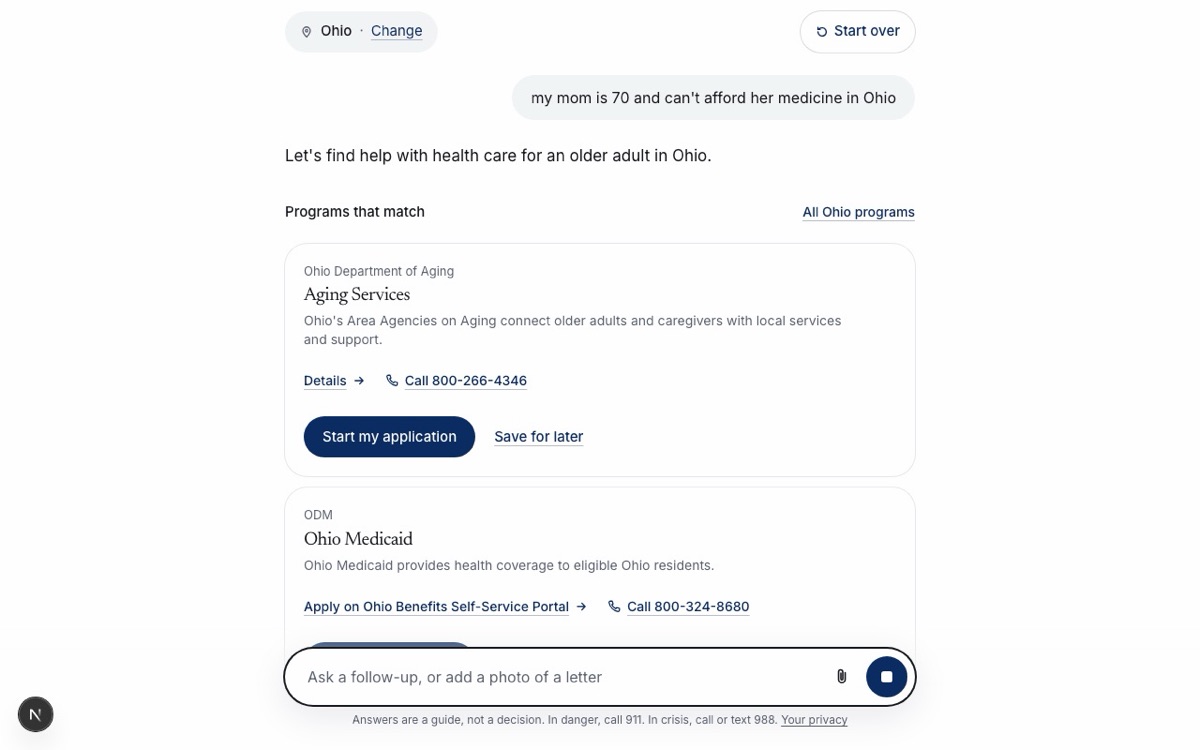
Front Door now reads your first question for what you need, before it answers. Ask “my mom is 70 and can’t afford her medicine in Ohio” and the first cards are help for older adults: Ohio’s Area Agencies on Aging, Medicaid, Extra Help with Medicare drug costs and Medicare. Before, a children’s health program could show up near the top.
- We read the kind of help, who it is for (you, your kids, an older adult, a veteran, someone with a disability, your family), whether it is urgent, and the language. The programs that fit best come first.
- The first cards come sooner: in under a second for most questions, down from about 1.3 seconds in our tests. A food question waits a moment longer, about 1.3 seconds, so the places near you come first. The first line says what we are looking for, in English or Spanish.
- Food places near you still go strictly by distance. A place farther away never shows above a closer one. When two places are the same distance away, the one that fits your words best comes first.
- Local offices are ordered by how well they fit what you asked, after the ones that handle that kind of help.
- Your name and any Social Security, card, bank, ID or case number are taken out before we read your words.
- Our rules still decide who qualifies. Reading your question only changes which cards come first.
- If the reading is slow or does not work, you get the same cards as before.
Behind the scenes:
- Every office, nonprofit, food site and program can now be tagged with the kind of help, who it serves, walk in or appointment, whether to bring ID, and possible duplicates. Ones we are not sure about wait on our working board for a person to look.
- When a link is broken and we find a new page, we now check that it is the official page for that office, not just a page that mentions its name.
Try it: ask about Ohio, ask about Washington or ask in Spanish about California.